Skip to content
Call (505) 371-4111
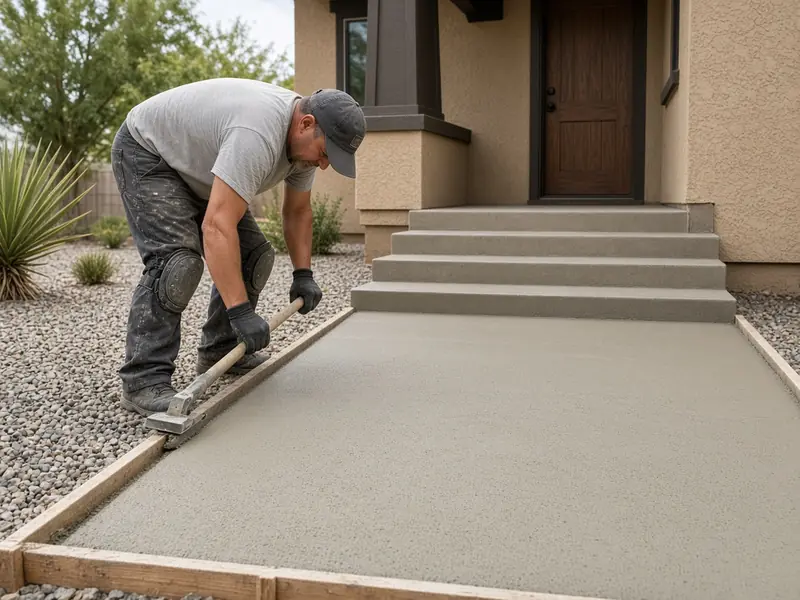
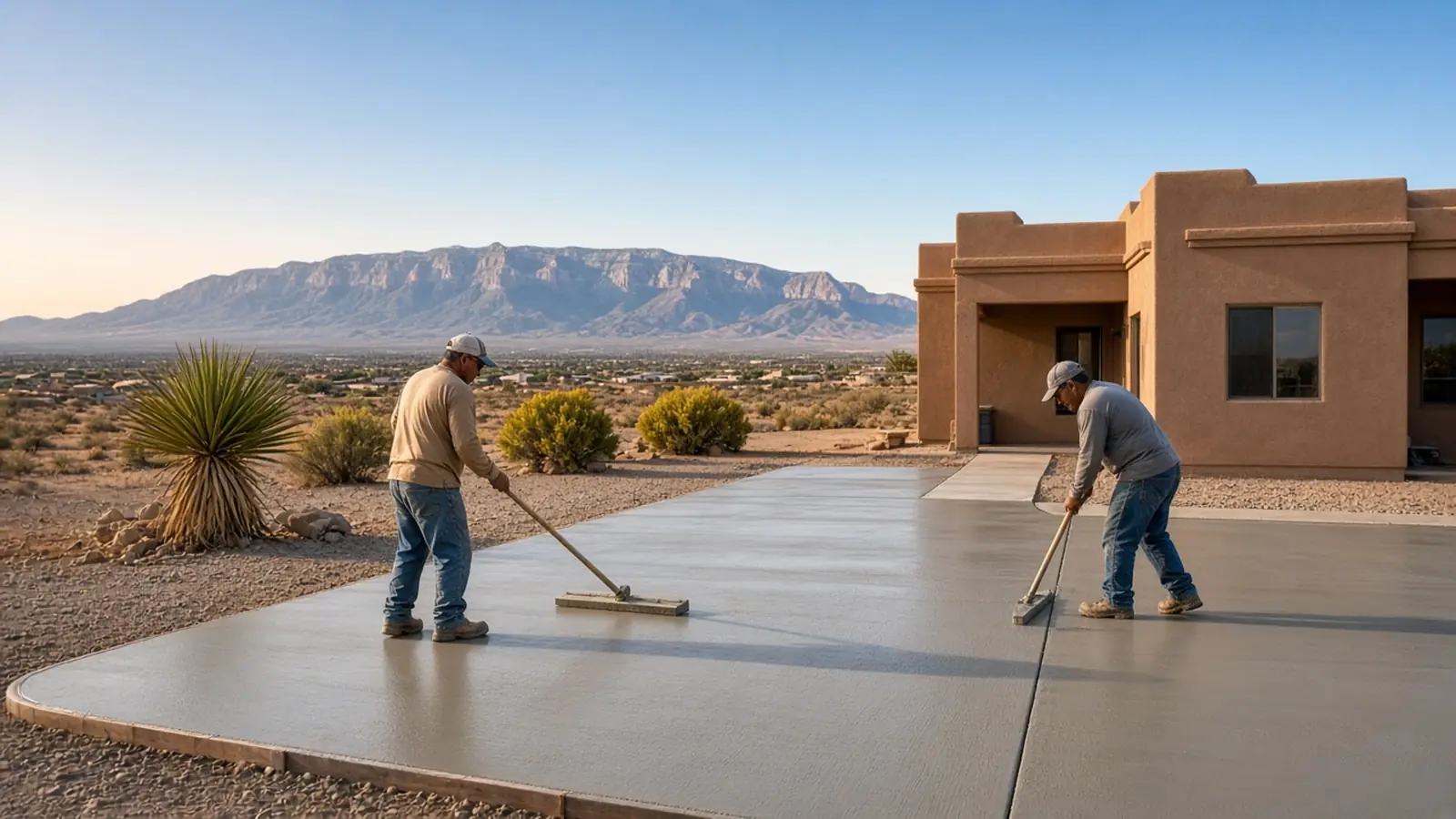
Two workers floating a freshly poured concrete driveway in front of a stucco home, with the Sandia Mountains behind

Rio Rancho Concrete Contractor - Driveway, Patio, Slab & Commercial Concrete Installation & Repair | Rio Rancho Concrete Works

Rio Rancho Concrete Works installs and replaces concrete driveways, patios, slabs and walkways for Rio Rancho homeowners, and builds flatwork, parking areas and pads for businesses and property managers. On high-desert ground, a slab lasts as long as the soil under it stays put, so that's where our work starts.

Tell us what you want poured or fixed, and we'll set up a site visit and send a written, line-by-line quote. Call (505) 371-4111 anytime, or send the quote form.

Request a site visit and itemized quote

Rather talk it through?

(505) 371-4111

Call anytime or send the form. Either way, you get a site visit and an itemized quote.

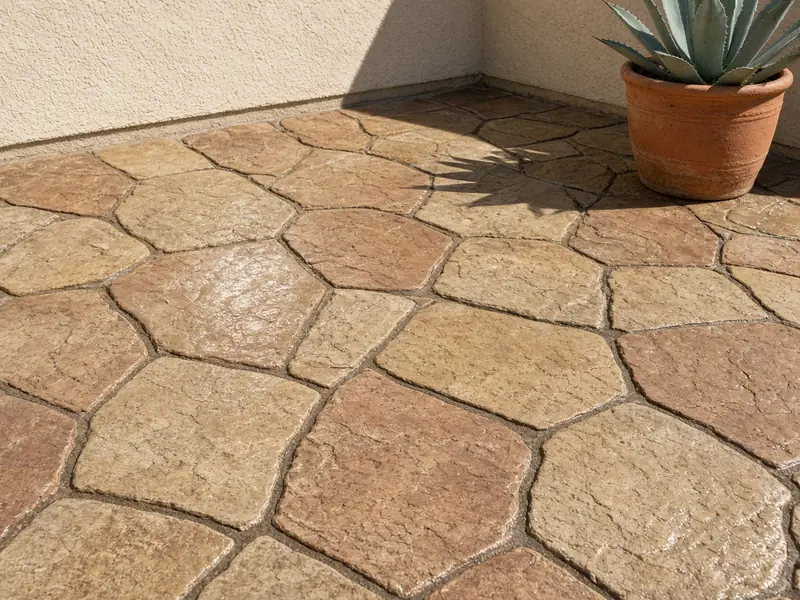
Sealed stamped concrete patio in a warm flagstone pattern with a potted agave
  • Site visit before every quote
  • Line-by-line written pricing
  • Homes and commercial properties
  • Base prep planned for desert soils

Residential Concrete Services in Rio Rancho

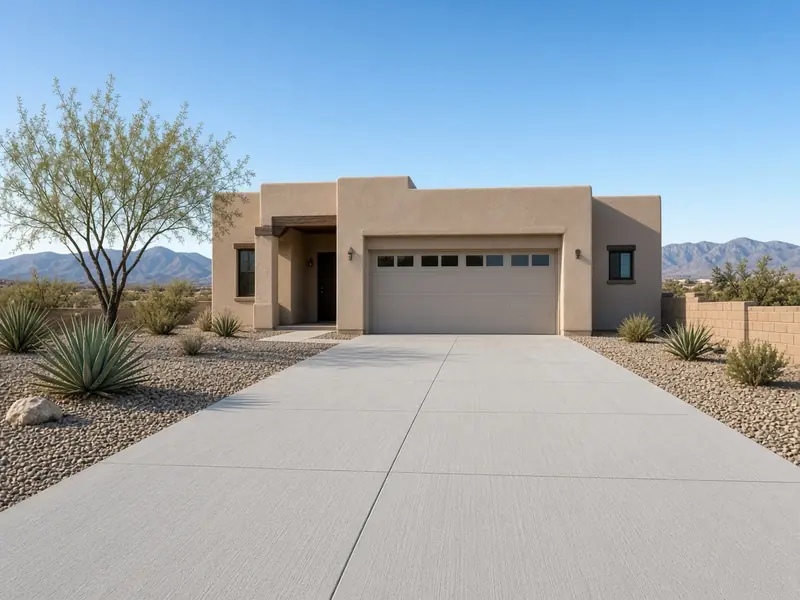
New broom-finish concrete driveway with saw-cut joints leading to the garage of a tan stucco home

Concrete Driveway Installation and Replacement

Your driveway carries the heaviest loads on the lot, and in Rio Rancho it also sits in full sun at more than 5,000 feet, swings through freezing nights in winter, and catches summer storm runoff. We break out tired driveways that have cracked, sunk or crumbled at the edges and pour new ones over a compacted base. HomeGuide's guidance is at least 4 inches of concrete for everyday cars, 5 to 6 inches for RVs and heavy trucks, and thickened edges of 6 to 8 inches, and we set thickness by what will actually park there. Joints are laid out before the pour so the slab cracks along straight lines we picked, not across the middle.
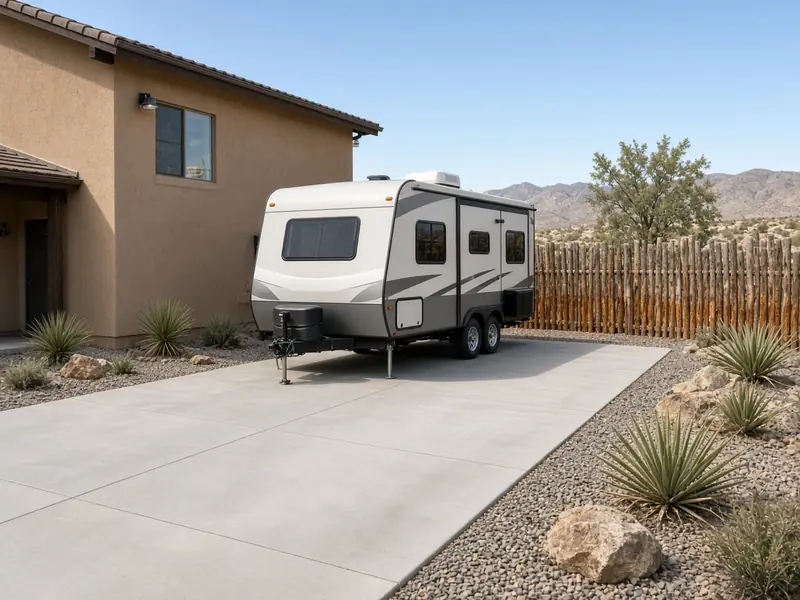
New concrete RV pad along the side yard of a stucco home with a travel trailer parked on it

Driveway Widening, RV Pads and Side-Yard Parking

Plenty of Rio Rancho homes came with a two-car driveway and a side yard that now holds a trailer, a boat, a work truck or a third car. Widening the driveway or adding an RV pad turns loose dirt or gravel into a solid, level place to park that doesn't track dust into the garage. We match the new section's height, slope and joint lines to what's already there, so it reads as part of the original driveway, and we thicken pads that will carry trailers or motorhomes.

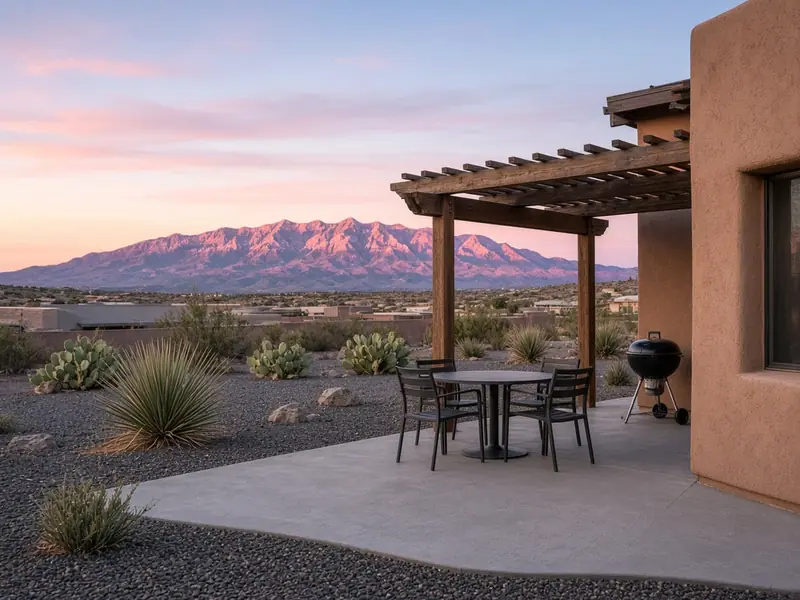
New concrete patio under a wood pergola with the Sandia Mountains glowing at sunset

Concrete Patios and Backyard Slabs

In a climate this dry, a lot of living happens out back, and a patio is usually what makes a yard usable. We form patios in whatever shape suits the house: a straight slab off the back door, an L that wraps a corner, or a larger pad with room for a table, a grill and shade. Each patio is pitched slightly away from the foundation so monsoon downpours run into the yard instead of soaking the soil against the house. If a hot tub or outdoor kitchen is in the plan, say so early; Angi's guidance is a 6- to 8-inch reinforced slab for loads like those.

Sealed stamped concrete patio in a warm flagstone pattern with a potted agave

Stamped and Decorative Concrete

Stamped concrete copies the texture of flagstone, slate, brick, tile or wood plank for less than the real material costs, and it pairs well with Southwest-style homes. Color is mixed in or broadcast on top, the pattern is pressed while the surface is still workable, and a contrasting release adds the shading that keeps it from looking flat. Stamping is a race against the set time, which in dry desert air can be short, so we staff stamped pours heavier than plain ones. You'll see sample colors and patterns before anything is ordered.

New concrete walkway and front steps leading to a stucco home with desert landscaping

Walkways, Steps and Front Entries

Sunken walkway panels, chipped steps and entries that have pulled away from the porch make a house look neglected and create trip edges. We replace broken sections, pour new paths from the driveway to the front door or around to the backyard gate, and form new steps and landings. A broom finish gives good footing when the surface is wet or icy, and a colored border or stamped band can dress up an entry without stamping the whole walk.

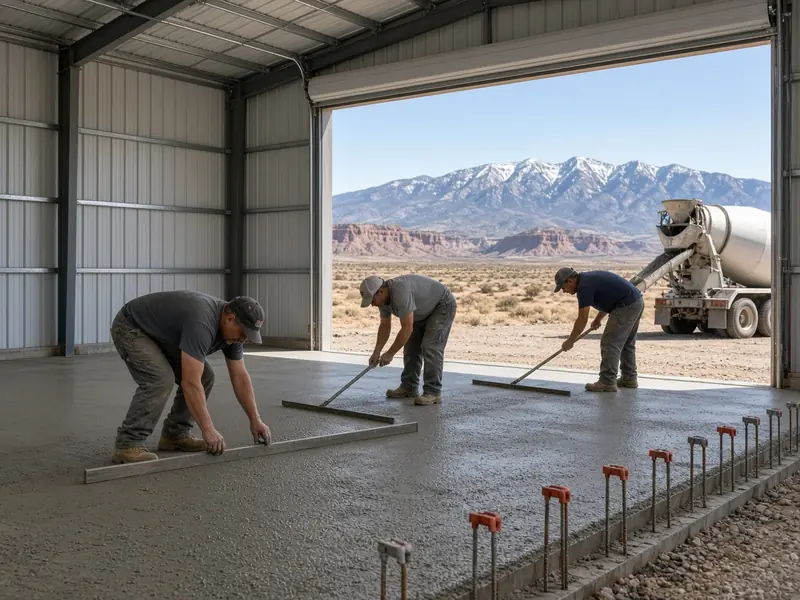
Crew finishing a fresh concrete slab inside a metal workshop with mountains in the distance

Garage Floors and Workshop Slabs

Garage and detached shop floors hold vehicles, tool chests, lifts, gym equipment and whatever else ends up in there. We pour these slabs over compacted base, add a vapor barrier where the floor will be enclosed, and size the thickness to the use. If you plan to put down an epoxy or polyaspartic coating later, tell us at the quote, since the finish we give the slab affects how well a coating bonds.

Pads for Sheds, Hot Tubs, AC Units and Generators

A small square of concrete under a shed, spa, mini-split, generator or water heater keeps the equipment level and off the dirt. Small pads still need real prep: we dig out loose soil, compact a base, square and level the forms, then pour. The City of Rio Rancho lists hot tubs and spas, and sheds and other secondary structures of 121 square feet and over, among projects that need a permit, so we'll flag that before your pad goes in.

Exposed Aggregate, Integral Color and Stained Finishes

Stamping isn't the only upgrade. Exposed aggregate washes the top cement paste away to reveal the stone underneath, giving a rough, grippy surface that hides dust and tire marks well. Integral color tints the mix all the way through, so a chip doesn't show gray. Acid and water-based stains add mottled color to new or existing slabs. In strong sun, some finishes and sealers hold their color better than others, and we'll talk through which suits your patio or driveway.

Commercial Concrete Services in Rio Rancho

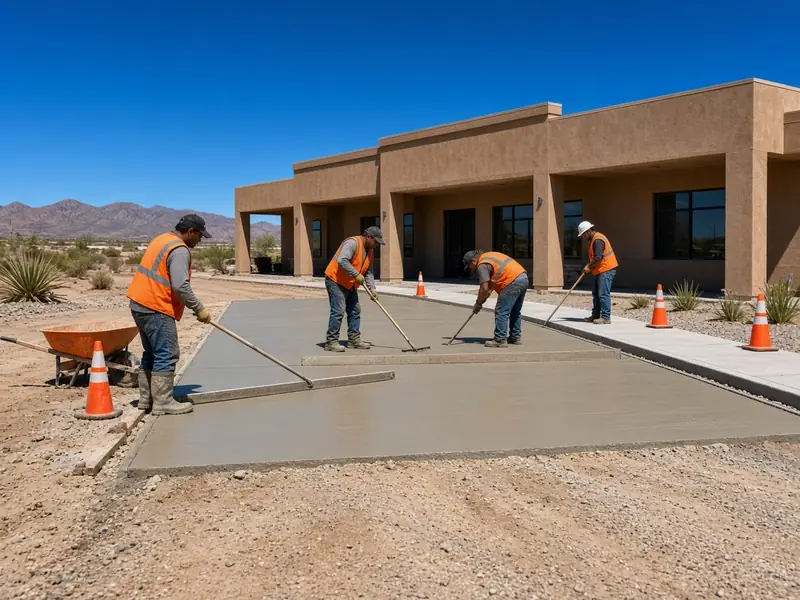
Crew in high-visibility vests placing new concrete flatwork in front of a stucco commercial building

Commercial Flatwork and Site Concrete

Shopping centers, office parks, medical buildings, churches, schools and apartment communities all run on flatwork: entry walks, plazas, patios and pads. We price commercial work from your plans or a site walk, and our bids break out thickness, reinforcement, base and finish as separate lines so you can compare contractors on equal terms. We phase pours so tenants, patients or customers always have a way in.

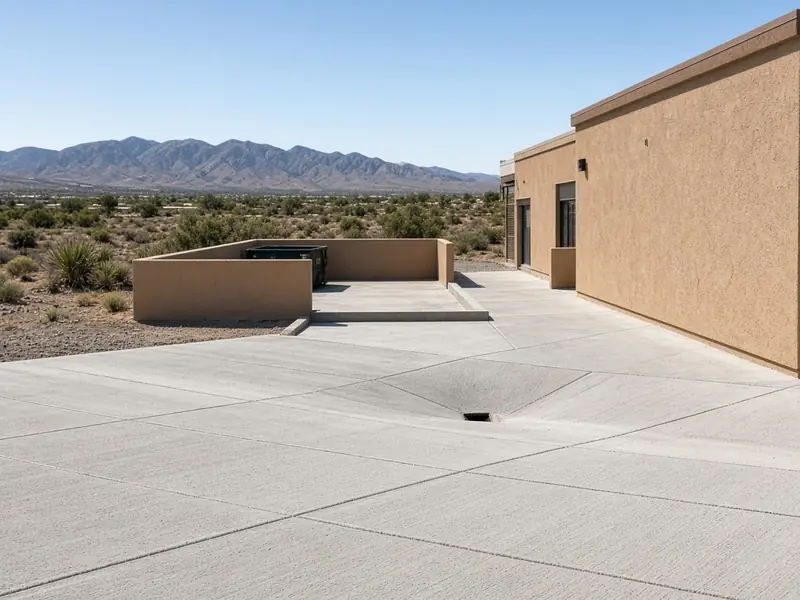
New concrete parking area with saw-cut joints, a drain inlet and a stucco dumpster enclosure

Concrete Parking Areas and Drive Lanes

Concrete costs more than asphalt on day one and lasts longer: for driveways, HomeGuide puts concrete's lifespan at 30 to 40 years against 15 to 30 for asphalt. We grade, compact and pour parking areas and drive aisles with joint layouts designed for the traffic they'll see, and slope them to inlets so storm water doesn't pond. Heavier sections go where trash trucks, delivery vehicles and fire apparatus turn and stop.

Sidewalks, Curb and Gutter, and Driveway Approaches

Concrete in a city right-of-way, such as a driveway approach, a sidewalk or a run of curb and gutter, falls under the City of Rio Rancho's right-of-way rules. The City requires a right-of-way use permit for that work, a separate curb cut location approval for new curb cuts, and a contractor with a current City business license, an excavation bond and insurance on file. The City's standard specifications also set the mix for right-of-way concrete: at least 3,000 psi at 28 days and 3 to 6 percent entrained air. We schedule approaches and sidewalks around those steps.

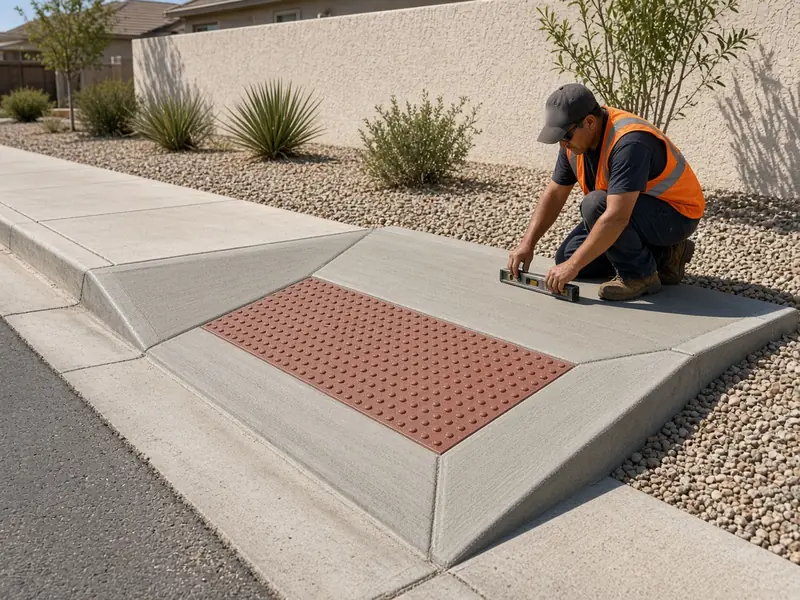
Worker finishing a new concrete curb ramp with a red detectable warning panel

ADA Curb Ramps and Accessible Routes

Accessible ramps and walks leave almost no room for error. Under the 2010 ADA Standards, a ramp's running slope can't be steeper than 1:12 and its cross slope can't be steeper than 1:48. That's set in the forms, not fixed afterward, so we check ramp and landing forms against the design slopes before the concrete truck is called.

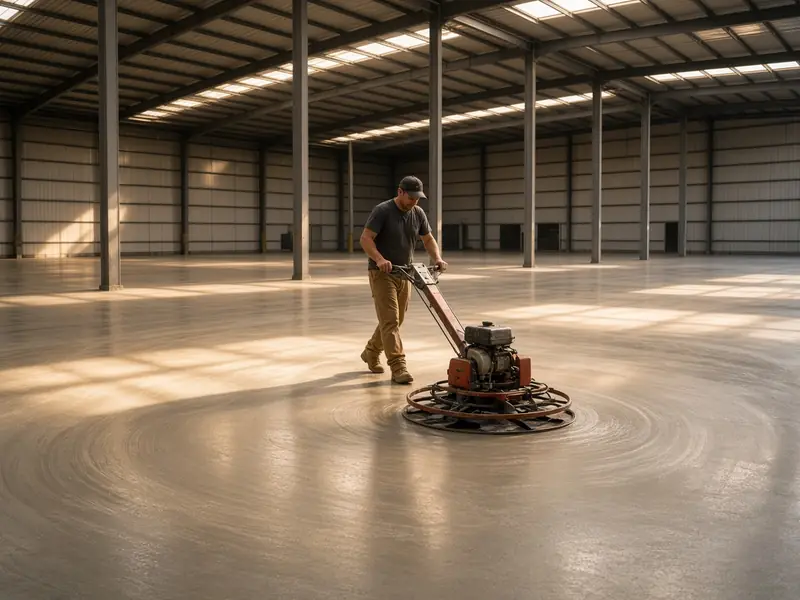
Worker running a walk-behind power trowel across a new warehouse floor slab

Warehouse, Shop and Industrial Floors

Warehouse and industrial floors have to carry forklifts, racking and rolling loads without curling at the joints or dusting at the surface. These slabs follow the engineer's design for thickness, reinforcement and joint spacing, sit on a firm, tested subgrade and compacted base, and get a tight, flat finish for equipment. We plan the saw-cut layout and pour sequence in advance so joints land where racking and traffic lanes can work around them.

Dumpster Pads, Loading Aprons and Equipment Pads

Every pickup, a loaded trash truck drops its front wheels and forks onto the same few square feet, and asphalt in those spots ruts and breaks apart. A thick concrete pad holds up. We also pour loading dock aprons, transformer and generator pads, and rooftop-unit or chiller pads at grade, built to the size and thickness on your drawings.

Pole Barn, Ranch and Outbuilding Slabs

If your property has a barn, pole building, horse facility or equipment shed that went up on a dirt floor, a slab makes it far more useful. We pour slabs inside existing buildings, aprons in front of big roll-up doors, and wash pads for trailers and equipment. When the building is already standing, we work out truck or pump access before the pour day.

Concrete Repair, Replacement and Leveling

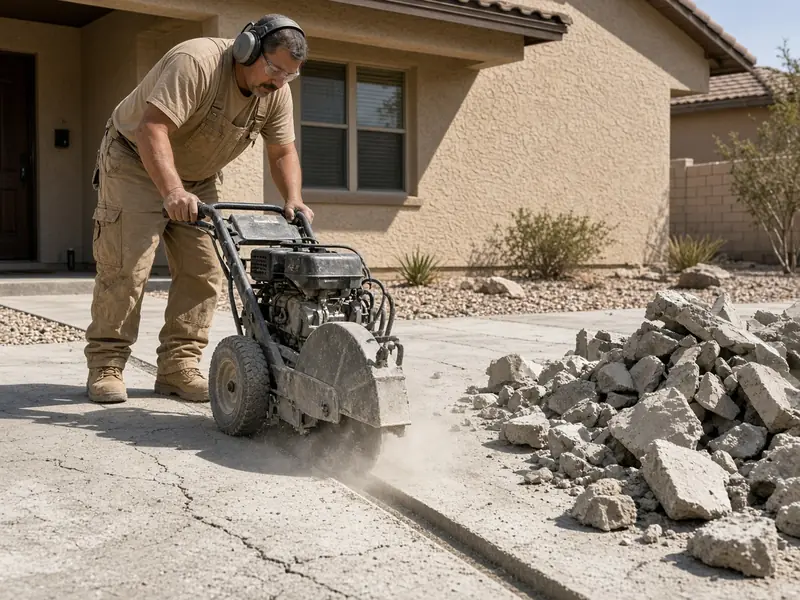
Worker saw-cutting a straight line through an old cracked concrete slab before removal

Concrete Removal and Replacement

When a slab has broken into pieces, heaved, or dropped at one corner, patching it is a short-term fix. Replacement means saw-cutting clean edges, breaking out and hauling off the old concrete, correcting whatever failed underneath (often wet or loose soil), and pouring new. If only a few panels have failed and the rest is sound, we'll replace just those and tell you honestly when the whole slab is due.

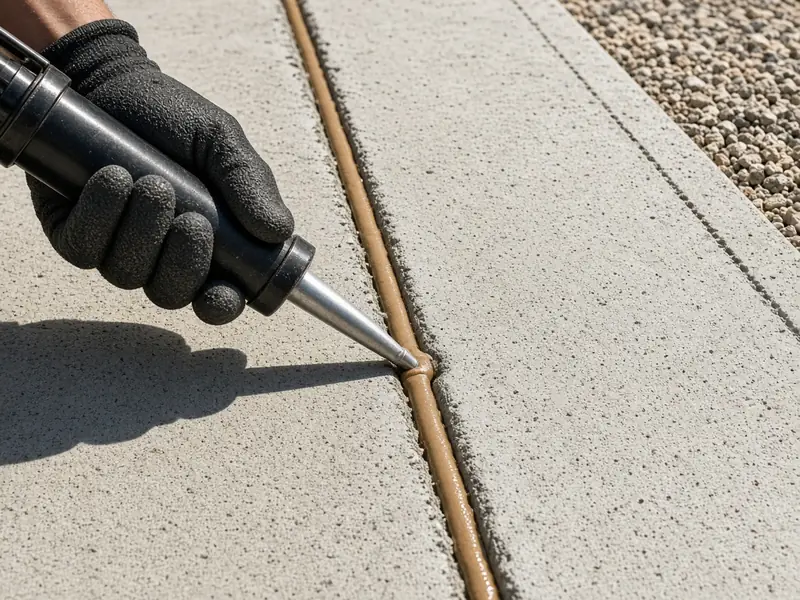
Gloved hand sealing a cleaned control joint in a concrete driveway with tan flexible sealant

Crack Repair and Joint Sealing

Fine shrinkage cracks are normal in concrete. Cracks that keep widening, shift up and down, or let water through are a different story, especially on desert soils that can settle when they get wet. We rout and clean open cracks and joints and fill them with flexible sealant so storm runoff and irrigation water stay on top of the slab instead of soaking the ground below it.

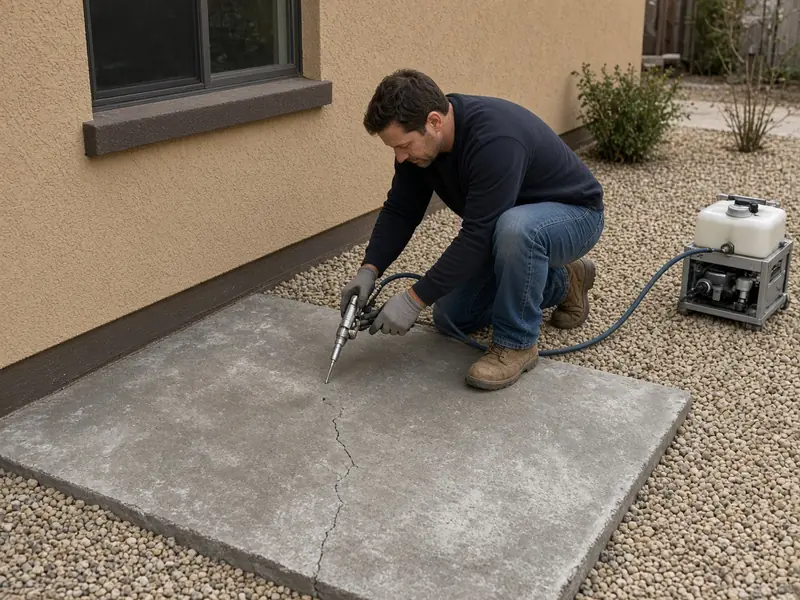
Slab leveling equipment beside a sunken concrete panel next to a stucco house

Slab Leveling: Mudjacking and Polyjacking

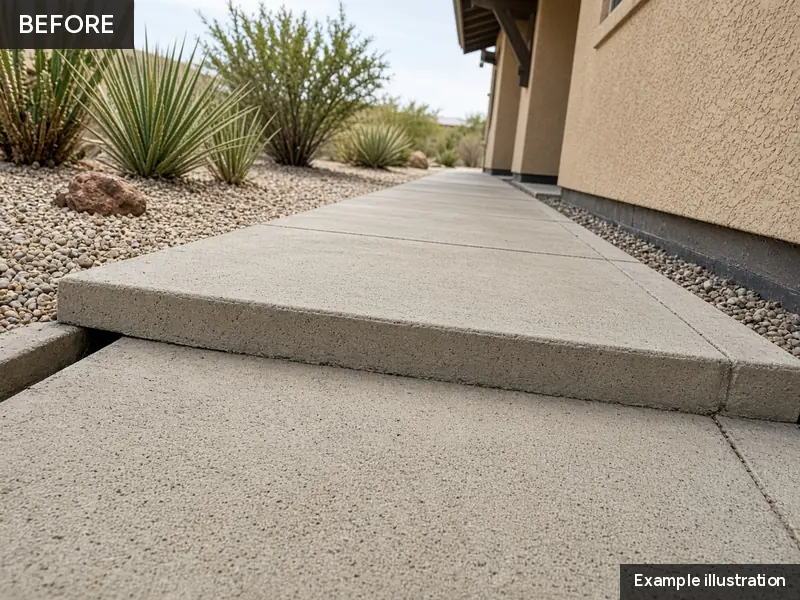
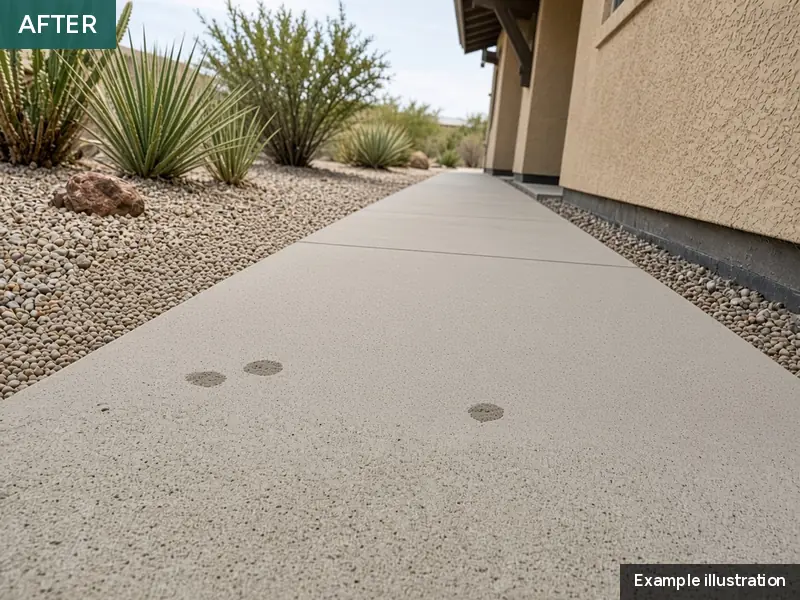
A sunken sidewalk panel, a patio that's tipped toward the house, or a driveway that's dropped at the garage can often be raised instead of replaced. Mudjacking pumps cement-based slurry under the slab through drilled holes; polyjacking uses expanding polyurethane foam through smaller ones. The slab rises back into place, and the holes are patched. Leveling works only on concrete that's still in one piece, so we check that before we recommend it.

Resurfacing and Concrete Overlays

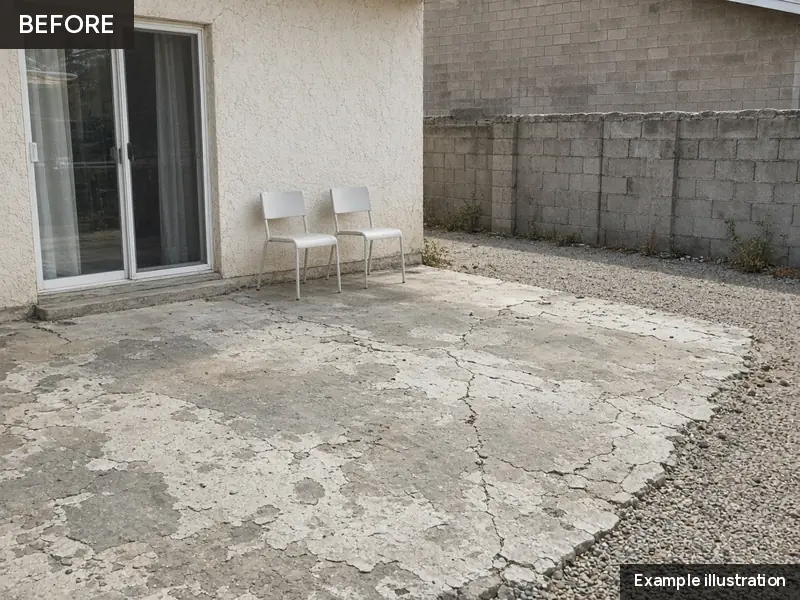
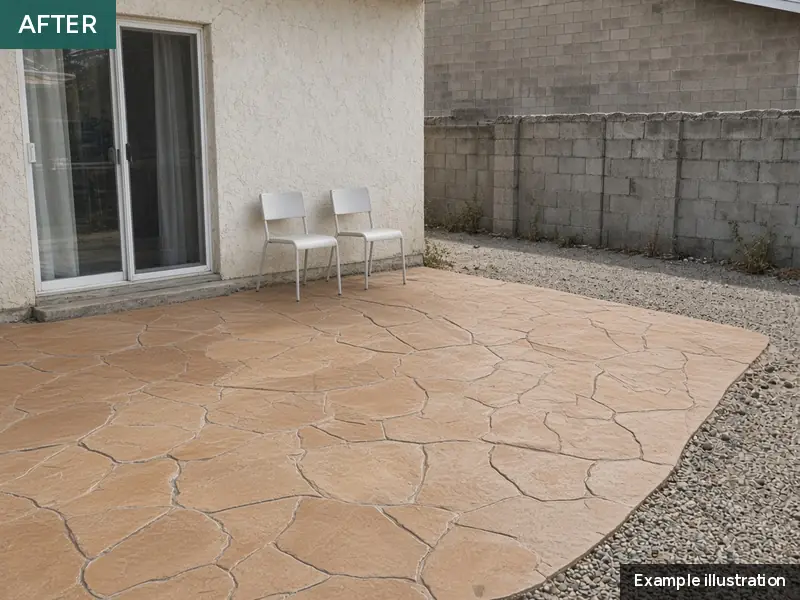
Concrete that's solid underneath but flaking, pitted, stained or simply dull can get a new wearing surface without a tear-out. A cement-based resurfacer bonds a thin new layer to the cleaned and repaired slab, and a decorative or stamped overlay can change the look of a plain patio entirely. Overlays don't fix a slab that's moving, so they're for surface problems only.

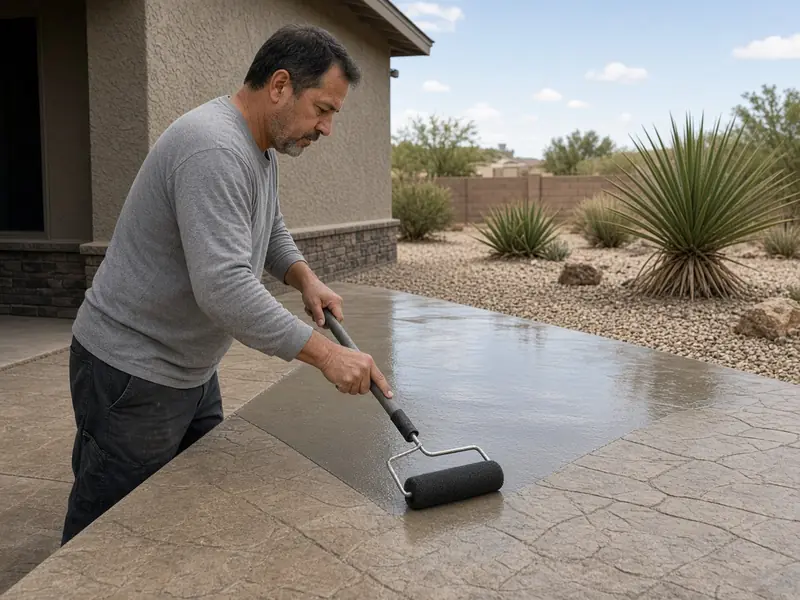
Worker rolling clear sealer onto a stamped concrete surface

Concrete Sealing

A good sealer slows water, oil and deicer from soaking into the surface, and on colored or stamped concrete it helps the color hold up against sun. HomeGuide's guidance is to let new concrete cure about 28 to 30 days before the first coat and to reseal every 2 to 3 years. We'll match the sealer type to the slab and how it's used.

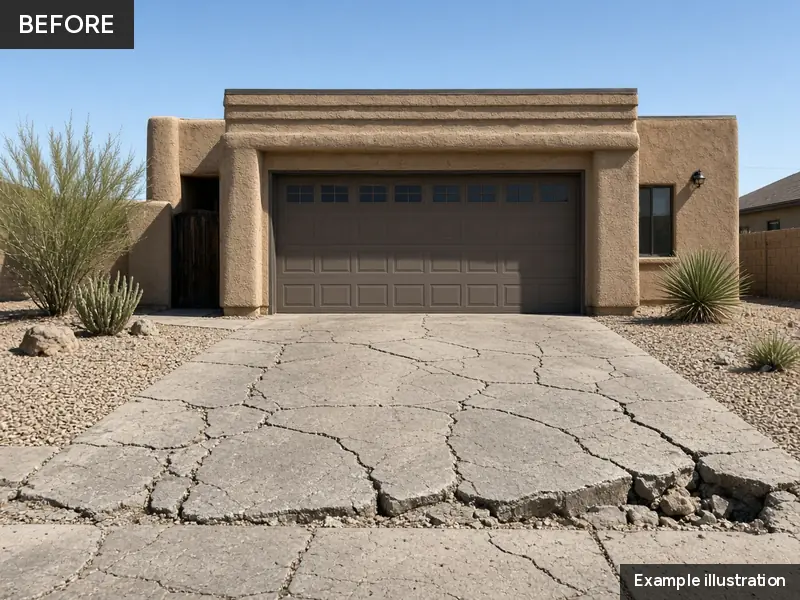
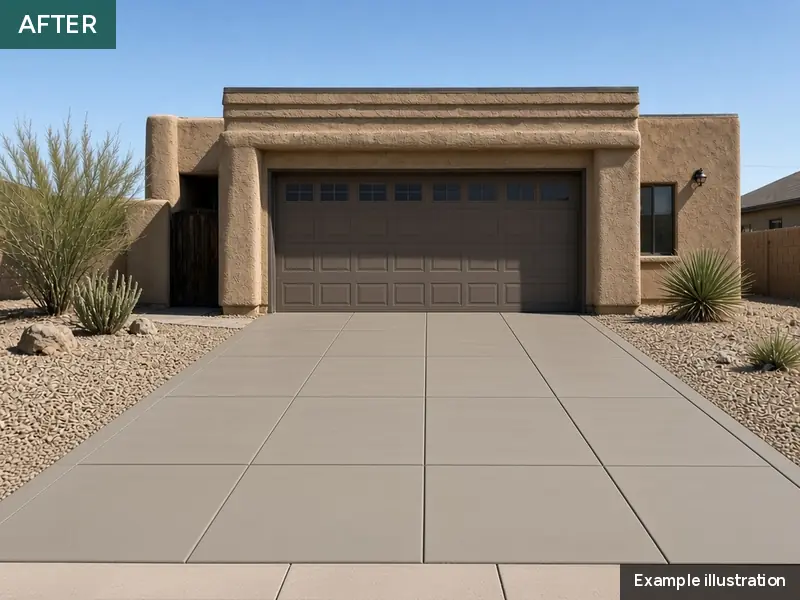
Example illustrations, not photos of completed projects.

Driveway replacement
Example illustration: a cracked, broken concrete driveway in front of a stucco garageExample illustration: the same driveway replaced with new broom-finish concrete and straight saw-cut joints
Walkway panel leveling
Example illustration: a sunken walkway panel with a raised trip edge beside a stucco houseExample illustration: the same panel lifted level with its neighbor and the holes patched
Patio overlay
Example illustration: a worn, flaking concrete patio outside a sliding doorExample illustration: the same patio with a stamped flagstone-pattern overlay

Why Rio Rancho Concrete Works

We think most concrete failures are decided before the truck arrives. A slab poured on loose fill, a base that was never compacted, missing joints, a downspout dumping onto the edge, or a pour scheduled into a hard freeze or a hot, windy afternoon causes more callbacks than the concrete itself. So our time goes into the parts you stop seeing once it's poured: digging out loose material, compacting the base, setting forms to drain, laying out joints, and planning around the weather. Each of those steps shows up as its own line on our quote, so you can see what you're paying for and line our price up against anyone else's.

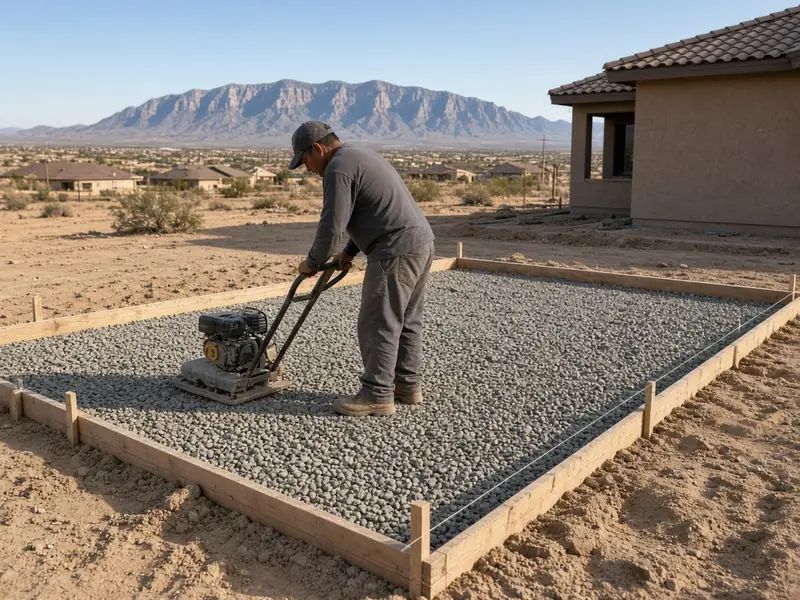
Worker running a plate compactor over a gravel base inside new forms, with the Sandia Mountains behind

Building on Rio Rancho's High-Desert Ground

Soils That Change When They Get Wet

Collapsible soils are a known problem in central New Mexico. The New Mexico Bureau of Geology and Mineral Resources describes collapsible soils as common in the state: soils that compact and settle after they get wet, often when water from roofs, roads, leaking lines or septic systems soaks in. Geotechnical reports in Rio Rancho show how much the ground varies. A 2023 report for a planned subdivision found low-expansive soils that still settled measurably when samples were soaked, and a 2024 report for a county building found loose soils in places down to 20 feet. That's why we compact the base on every job and treat drainage as part of the slab.

Caliche

New Mexico State University's Extension describes caliche as a soil layer cemented by calcium and magnesium carbonates, ranging from soft and thin to a hard, thick bed, and notes that it can stop water from moving deeper into the ground. For a concrete job, a hard caliche layer can slow digging for footings and posts, and water that can't soak through it can sit under a slab. We note caliche on the site visit and plan the excavation and drainage around it.

Freezing Nights, Mild Days

Rio Rancho's average January and December lows are 30°F, with average highs of 53°F, according to the climate table on the city's Wikipedia page. That means many winter days thaw out and then freeze again overnight. Water that gets into concrete expands every time it freezes, and over enough cycles that pops the surface off poorly made slabs. The American Concrete Pavement Association explains that properly air-entrained concrete resists scaling from freezing, thawing and deicers, because tiny air voids give freezing water room to expand. We quote air-entrained mixes for outdoor slabs.

Sun, Wind and Dry Air

At about 5,500 feet, Rio Rancho's sunlight is stronger than at sea level. The EPA says UV intensity rises about 6 percent per kilometer of elevation, which works out to roughly 10 percent more than at sea level here. Hot sun, low humidity and wind all pull water out of fresh concrete, and the City of Rio Rancho's own concrete specifications list those exact conditions as "hot weather" that can harm fresh concrete. In summer we start pours early, use evaporation retarders and curing compound, and keep the surface from drying out too fast.

Monsoon Storms

Rio Rancho averages 8.9 inches of precipitation a year, and roughly 45 percent of it falls from July through September, according to the same climate table. Those storms dump a lot of water in a short time onto ground that's usually bone dry, which is exactly the condition that makes loose soils settle. Every slab we pour is sloped to carry water away from foundations, and we look at where downspouts, irrigation and neighboring lots drain before we set forms.

5 Things to Know Before You Pour Concrete in Rio Rancho

  1. 1. Ask the City About Permits First

    The City of Rio Rancho advises calling its permit office at 505-891-5005 to ask whether a permit is needed before starting any home project. Its permit list includes retaining walls and fences; secondary structures of 121 square feet and over; and swimming pools, hot tubs and spas. A flat driveway or patio on your own lot isn't on that list, but a hot tub on the new patio or a retaining wall beside it is.

  2. 2. Work in the Street Needs a Right-of-Way Permit

    Driveway approaches, curb cuts and sidewalks in the public right-of-way need a City right-of-way use permit. The City's process asks for a complete application and a certified traffic control plan, says to submit at least 7 working days before work starts, and requires the contractor to have a City business license, an excavation bond of at least $10,000 and insurance on file. In unincorporated Sandoval County, right-of-way permits come from Sandoval County Public Works, and Corrales and Bernalillo are separate municipalities, so the rules depend on which side of the line your property sits.

  3. 3. Call New Mexico 811 Before Digging

    State law requires anyone excavating with mechanical equipment to give at least two full working days' notice through New Mexico 811, not counting the day of the request. Utility owners then mark their lines, and the standard locate is valid for 15 working days. Locates protect gas, water, power and fiber lines and keep a job from stopping halfway through excavation.

  4. 4. Check the Contractor's New Mexico License

    New Mexico's Construction Industries Division licenses concrete contractors under the GS-4 classification for concrete, cement, walkways and driveways, which covers mixing, pouring and finishing concrete, plus the excavation, forms and reinforcement that go with it. Under the same rule, a GS-4 contractor can't do that work in a public right-of-way unless it's subcontracted to a properly licensed GA contractor. You can check any contractor's license through the New Mexico Regulation and Licensing Department before you sign.

  5. 5. Cold and Heat Change the Schedule

    The American Concrete Institute treats air temperatures at or below 40°F during the protection period as cold weather for concrete. On City right-of-way work, Rio Rancho's specifications call for a cold-weather plan when temperatures are likely to drop below 40°F, keep the mix between 50°F and 90°F at placement, and require at least 7 days of curing for standard concrete. Pours can still happen in winter and summer, but sometimes the right move is a different day.

Concrete Materials and Methods

Subgrade and Base

Concrete is strong in compression but cracks when the ground under it moves. Rio Rancho's own specifications say concrete can't be placed on mud or an uncompacted subgrade, and that unstable spots have to be dug out and replaced with compacted material. We hold private jobs to the same idea: remove loose soil and organics, compact the base in lifts, moisten it before the pour, and fix soft spots before forms go up.

Reinforcement: Rebar, Wire Mesh and Fiber

Reinforcement doesn't keep concrete from cracking; it holds cracks tight so the slab stays flat and in one piece. Rebar grids suit driveways and heavier slabs, welded wire mesh is common in lighter flatwork, and synthetic fibers help control early surface cracking. HomeGuide notes that steel rebar improves durability and crack resistance, especially where freeze-thaw cycles happen.

Air-Entrained Mixes

Air entrainment fills the mix with tiny, closely spaced air bubbles. The City of Rio Rancho requires 3 to 6 percent entrained air in concrete placed in its right-of-way, and the American Concrete Pavement Association credits properly air-entrained concrete with excellent resistance to freeze-thaw and deicer scaling. We use air-entrained mixes for exterior flatwork.

Control Joints

All concrete shrinks as it cures. Control joints, tooled in or saw-cut on a planned spacing, give that shrinkage a straight path so cracks don't wander across your patio. Cutting joints late or skipping them is one of the most common reasons for random cracks.

Curing in Dry Air

Concrete doesn't dry; it cures through a chemical reaction that keeps going for weeks, and it needs moisture to do it. HomeGuide's timeline is foot traffic after 24 to 48 hours, light vehicles after about 7 days, and full strength around 28 to 30 days. In Rio Rancho's dry air, we cover the slab or spray it with curing compound right after finishing so the surface doesn't lose its water too early.

How a Concrete Project Works With Us

  1. 1. Site Visit

    We measure, check drainage, soil and access for the concrete truck, and listen to how you want to use the space. Photos of finishes you like help a lot.

  2. 2. Written Quote

    You get a written quote with removal, base, thickness, reinforcement, finish and any permits listed separately, so you can decide what to do now and what can wait.

  3. 3. Permits and Utility Locates

    If the job touches the right-of-way or includes a hot tub, wall or structure that needs a permit, those steps go on the schedule. New Mexico 811 locates are requested before any digging.

  4. 4. Tear-Out, Excavation and Base

    Old concrete comes out, loose soil is dug out, and the base is placed and compacted. Forms and reinforcement are set and checked for slope before the pour is booked.

  5. 5. Pour and Finish

    Concrete is placed, screeded, floated and finished to the texture you picked, and joints are tooled or cut on time. Color and stamping happen in this window.

  6. 6. Cure, Clean Up and Walk-Through

    We protect the slab while it cures, haul off debris, and walk the finished work with you. You'll get care notes covering when to drive on it and when to seal it.

Concrete Cost Guide: National 2026 Ranges

These are national figures from published 2026 cost guides, not Rio Rancho quotes. Your price depends on size, thickness, tear-out, base work, access and finish, and you'll see exact numbers on your written quote.

  • Concrete driveway: $6 to $15 per square foot, or $2,400 to $8,600 for a typical two-car driveway (HomeGuide). Removing an old driveway adds about $2 to $6 per square foot, grading runs $3 to $8 per square foot, and rebar adds about $1 to $3 per square foot.
  • Concrete patio: a national average of $3,557, with most homeowners paying $1,919 to $5,393 (Angi).
  • Stamped concrete patio: $8 to $19 per square foot, or $3,200 to $7,600 for a 20-by-20-foot patio (HomeGuide).
  • Concrete slab: $6 to $12 per square foot; a two-car garage floor runs $2,400 to $6,900 (HomeGuide).
  • Sidewalks and walkways: $7 to $17 per square foot installed (HomeGuide).
  • Slab leveling: mudjacking $4 to $9 per square foot and polyjacking $8 to $25, with job minimums of $300 to $700 common (HomeGuide).
  • Sealing: about $1 to $3 per square foot (HomeGuide).
  • Commercial work: priced from plans or a site walk, because thickness, reinforcement and phasing vary too much for a fair national range.

Combine projects when you can. Every concrete truck and crew trip carries a minimum cost, so a patio, a walk and an equipment pad poured the same day usually cost less than three separate jobs.

Read low bids closely. The usual surprises are tear-out and haul-off left out, base work billed later, a thinner slab than you expected, and nothing written about joints or reinforcement.

Serving Rio Rancho and the West Side

Rio Rancho is the largest city in Sandoval County and the third-largest in New Mexico, with 104,046 residents at the 2020 Census and an estimated 114,419 by July 2025, according to the U.S. Census Bureau. It grew out of the Rio Rancho Estates development that began in the early 1960s and incorporated as a city in 1981. Today the City Centre area holds City Hall, the Santa Ana Star Center, and campuses for UNM Health Sciences and Central New Mexico Community College, all with the Sandia Mountains on the eastern skyline. We pour concrete across the city, from Cabezon on the south side and Enchanted Hills to Loma Colorado in the middle, Northern Meadows and Mariposa on the northwest side, North Hills, High Resort and Rio Rancho Estates. We also take projects in neighboring Corrales and Bernalillo, in northwest Albuquerque along the city's southern border, and out toward Placitas.

SANDIASRIO RANCHOCorralesBernalilloPlacitasNW Albuquerque

Concrete Questions Rio Rancho Homeowners Ask

How soon can I drive on a new concrete driveway?

Plan on about a week for everyday cars. HomeGuide's guidance is foot traffic after 24 to 48 hours, light vehicles after about 7 days, and full strength around 28 to 30 days, so keep trailers and heavy trucks off until then.

Do I need a permit for a driveway or patio in Rio Rancho?

A flat driveway or patio on your own lot isn't on the City's permit list, but the City recommends calling the permit office at 505-891-5005 before any project. Work in the street, including driveway approaches, curb cuts and sidewalks, needs a right-of-way use permit, and hot tubs, retaining walls and sheds of 121 square feet and over have their own permit requirements.

Why does concrete crack around here, and can you prevent it?

All concrete shrinks as it cures and moves with temperature, so some cracking is normal. In Rio Rancho, settling soil under a slab is the bigger risk, especially where roof or irrigation water soaks in. A compacted base, good drainage, the right thickness, reinforcement and well-placed joints keep cracks small, straight and tight.

Can you pour concrete in winter or summer?

Yes, with planning. Below about 40°F, concrete needs protection, and it can't go onto frozen ground. In summer, sun, wind and low humidity dry the surface fast, so we pour early and cure the slab right away. We'll move a pour date rather than risk your slab.

Should I repair, level or replace my concrete?

If the slab is mostly intact and has just settled, leveling or crack repair can buy years. If it's broken into pieces, heaved, or flaking across most of the surface, replacement is the better value. We make that call with you on the site visit.

Is stamped concrete a good choice in the high desert?

It can be, with an air-entrained mix, good drainage and regular sealing. HomeGuide's guidance is to reseal stamped concrete every 2 to 3 years, and sealer also helps the color hold up against strong sun.

What do you need from me for a quote?

Your address, rough measurements or a few photos, what's there now, and what you'd like poured or fixed. We'll measure on site either way.

Request a Concrete Quote in Rio Rancho

Send us your address and a short description of the project, and we'll set up a time to look at it. You'll get a written quote with each part of the job priced on its own line.

New concrete driveway with saw-cut joints in front of a tan stucco home

We'll reply by phone or email. Sending this form doesn't sign you up for text messages.

Rather talk it through? Call (505) 371-4111 anytime or email info@rioranchoconcreteworks.com.

Call (505) 371-4111Request a Quote